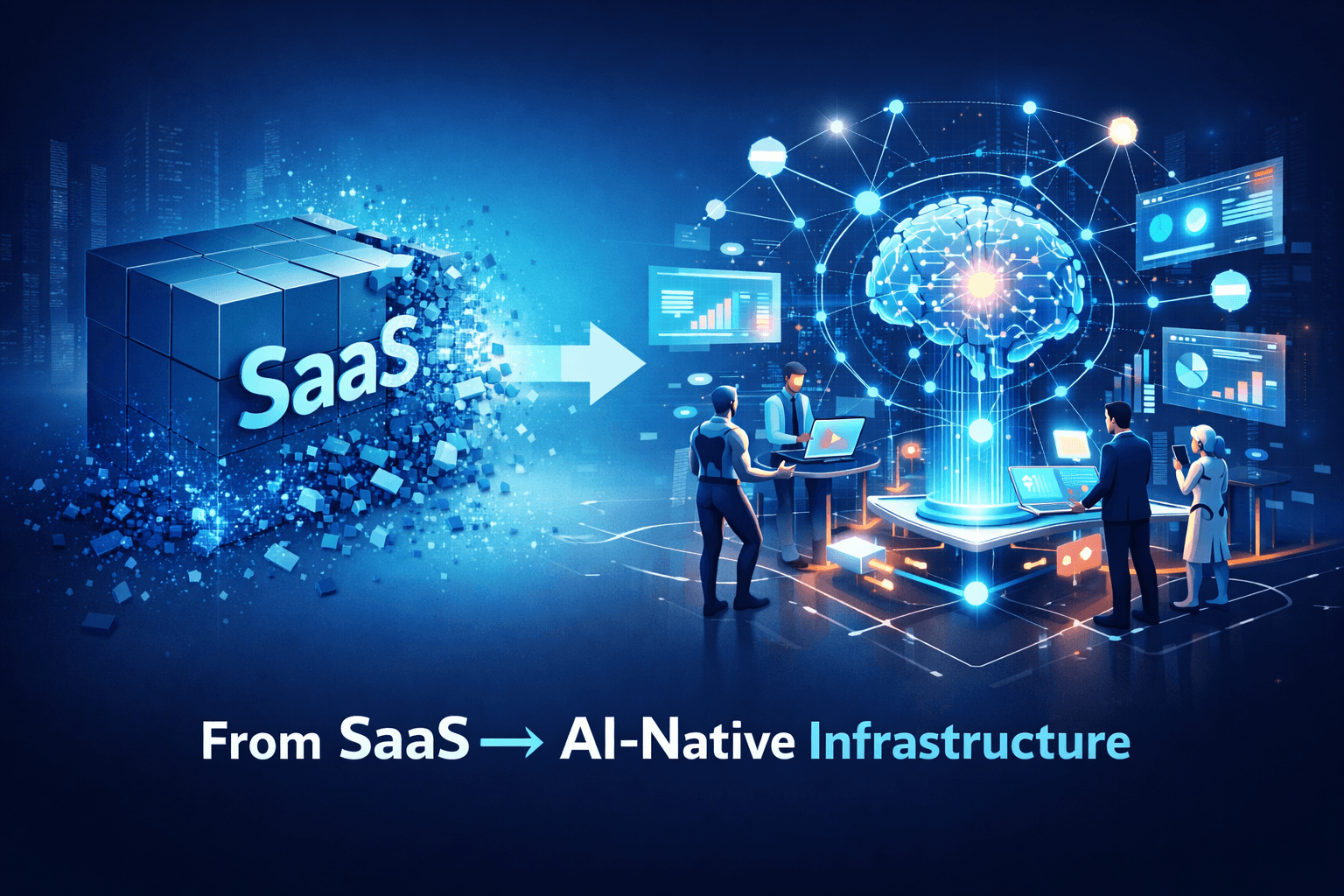
As businesses move beyond traditional software, AI-native infrastructure powered by agentic systems is redefining workflows and challenging legacy SaaS players.
For decades, businesses relied on Software-as-a-Service (SaaS) to streamline operations, from CRM platforms to analytics dashboards and productivity tools. SaaS promised convenience, scalability, and low IT overhead. Yet today, we are entering a new era: a shift from traditional SaaS to AI-native infrastructure, where intelligence is built into the very fabric of enterprise systems. At the forefront of this transformation is Simming.ai, leveraging agentic AI to automate, optimize, and orchestrate workflows in ways SaaS alone cannot.
The Next Paradigm: AI-Native Infrastructure
AI-native infrastructure isn’t just software with AI features, it’s intelligence embedded at every layer. At Simming.ai, every agent, workflow, and integration is designed to learn, adapt, and operate autonomously. Unlike traditional SaaS tools that require configuration and human oversight, AI-native systems predict outcomes, optimize operations, and even simulate decisions before execution.
These platforms do more than execute tasks faster; they redefine what organizations can do. Automation evolves from repetitive work to dynamic problem-solving. In effect, AI-native systems act as collaborators, working alongside humans to manage complex processes and uncover insights that static dashboards or manual workflows cannot.
Who Stays and Who Gets Disrupted
The shift to AI-native infrastructure has profound implications for traditional SaaS vendors. Platforms that treat AI as an add-on risk obsolescence. Just as cloud computing disrupted on-premise software, AI-first systems like Simming.ai’s agentic infrastructure are making rigid, manual SaaS tools less relevant.
In finance, logistics, marketing, or customer support, AI-native systems can continuously analyze patterns, optimize decisions, and take autonomous actions. Organizations using these systems gain real-time intelligence at scale, while traditional SaaS users remain limited by static interfaces and human-dependent processes. Simply put, the winners are those who embrace AI-native infrastructure, and the losers are those who cling to yesterday’s SaaS.
Simming.ai’s Agentic Systems: A New Layer of Reality
Much like the philosophical question of perception versus reality, executives must ask: Are current SaaS tools reflecting operational truth, or are they mere snapshots of complex processes? Simming.ai’s agentic systems function as a living simulation of your organization, modeling workflows, predicting outcomes, and continuously optimizing in real time.
This isn’t just efficiency, it’s a new way to understand and operate your business. Where traditional SaaS provides dashboards, AI-native infrastructure offers dynamic insights, proactive recommendations, and autonomous execution, transforming decision-making from reactive to predictive.
Engineering the Future: AI as the Infrastructure Layer
Transitioning to AI-native infrastructure is more than a technical upgrade, it’s a redefinition of enterprise architecture. Simming.ai designs agents that orchestrate work across departments, simulate scenarios before execution, and adapt continuously. Tasks that previously required hours of manual input are now handled autonomously, freeing teams to focus on strategy and innovation.
Furthermore, AI-native infrastructure enables safe experimentation. Marketing campaigns, supply chains, or operational strategies can be tested virtually, giving organizations the ability to iterate and optimize without risk to real-world operations. This mirrors how Simming.ai’s agents learn in digital environments before acting in production, ensuring smarter, safer decision-making.
Time, Scale, and the AI Advantage
AI-native infrastructure compresses decision cycles and scales intelligence across the enterprise. Processes that once took days or weeks now happen in real time, enabling organizations to pivot faster than competitors. Traditional SaaS, by contrast, often functions as a snapshot frozen in time, lacking the adaptive intelligence needed to respond dynamically.
Simming.ai’s approach transforms infrastructure from static tools to living, evolving systems, allowing businesses to anticipate challenges, optimize workflows continuously, and harness AI as a core collaborator rather than an afterthought.
Navigating the AI-Native Era
Adopting AI-native infrastructure comes with responsibilities: ethical AI use, human oversight, and robust data governance are essential. Yet when implemented thoughtfully, AI-native systems offer transformative potential: faster insights, smarter decisions, and the ability to scale intelligence across every process.
The transition from SaaS to AI-native infrastructure is more than a technical upgrade, it’s a paradigm shift. Organizations that embrace it thoughtfully gain a structural advantage, while those that resist risk being outpaced not just by competitors, but by the very systems that define the new digital economy.
The Human Perspective: AI as a Force Multiplier
AI-native infrastructure is not a replacement for human ingenuity, it is a force multiplier. Leaders who understand its capabilities and limitations can drive unprecedented operational efficiency and innovation. Those who ignore it risk falling behind in an era where AI-first systems, like Simming.ai, define what “enterprise capability” truly means.
In the end, the shift from SaaS to AI-native infrastructure is not just about tools; it’s about rethinking what software, intelligence, and business operations can accomplish. By embracing AI-native platforms and agentic systems, organizations move from reactive processes to dynamic, autonomous ecosystems, a transformation that is already reshaping industries today.