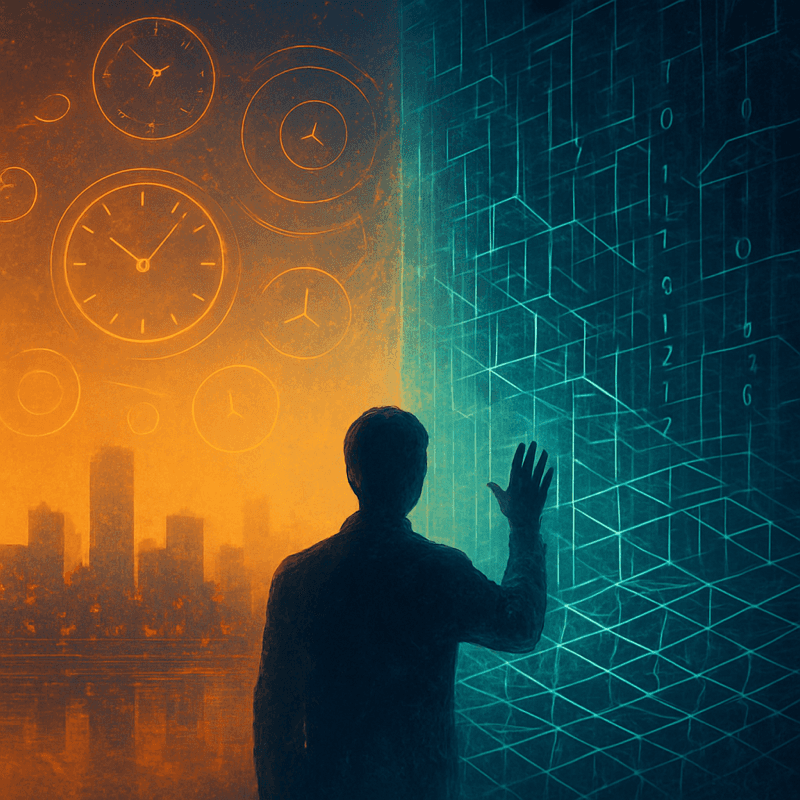
For millennia, humans have pondered whether the world we experience is truly “real” or merely a convincing illusion. From Plato’s Allegory of the Cave, where prisoners see only shadows on a wall and take them as reality to modern science fiction like The Matrix, we have been fascinated by the idea that life might be akin to a dream or a simulation. Today, this philosophical question has taken on new life in the form of the simulation hypothesis.
Oxford philosopher Nick Bostrom, in a famous 2003 paper, argued that if technological civilizations advance far enough, at least one of three outcomes must be true: either no civilization reaches the capability to run realistic universes, or they choose not to or we are almost certainly living in a simulation right now .
In other words, our reality could be an elaborate software program engineered by an intelligence beyond our own. It’s a startling idea that prompts us to question everything: How can we tell if our reality is “base” reality or an artificial construct? And does it even matter for how we live our lives?.
Perception vs. Reality: Is the World We See the World That Is?
Philosophers and scientists alike note that even if we aren’t literally inside a computer simulation, each of us lives in a mental simulation created by our own brains. Our senses provide limited data about the external world, and our brain works hard to interpret and fill in the gaps. In fact, what we perceive as reality is essentially a model that the brain constructs from sensory inputs, much like a virtual reality interface that simplifies and represents the outside world . We don’t see raw reality; we see our brain’s rendering of reality. Modern neuroscience and cognitive psychology suggest that our perception is not a passive recording of the environment, but an active process of inference. Some researchers even describe normal perception as a “controlled hallucination,” where the brain constantly makes predictions and adjusts them with incoming data.
This means much of what we experience: colors, sounds, the flow of time is heavily processed and sometimes deceptive. We have blind spots (literally in our vision and figuratively in our understanding) that our mind glosses over. Our eyes, for example, only detect a tiny slice of the electromagnetic spectrum; our ears hear only a narrow range of frequencies. Yet our brain extrapolates from this thin trickle of information to create a rich world of experience. Cognitive psychologist Donald Hoffman argues that evolution didn’t design our senses for truth but for survival. According to Hoffman, our perceptions act like a user interface hiding the underlying complexity of the real world and showing us only what we need to navigate it effectively . In his view, what we see is analogous to the icons on a computer desktop: useful symbols, not an accurate picture of the machine’s circuits. In other words, our experienced reality is a pragmatic illusion, shaped by what was beneficial for our ancestors rather than an objective mirroring of the environment.
Engineering Reality: How Technology Blurs the Line
While our brains have been “engineering” a version of reality for us since the dawn of consciousness, in recent decades human technology has begun to build external simulations and altered realities that further challenge our senses.
Virtual Reality, Augmented Reality, and Simulated Worlds
Engineers and computer scientists create virtual environments so immersive that they can be hard to distinguish from the physical world. Virtual reality (VR) headsets can pull us into computer-generated 3D worlds where our brain reacts as if it were all real heights make us dizzy, virtual threats make our heart race. Augmented reality (AR) overlays digital objects onto our view of the real world, merging the two seamlessly. These technologies are still maturing, but they improve each year, making the simulated aspects ever more convincing.
Perhaps even more striking is the rise of AI-generated content that mimics reality. Artificial intelligence can now produce incredibly realistic images, videos, and sounds. We have AI models that can generate a person’s likeness or voice so convincingly that an untrained observer might not notice the fabrication. For example, not long ago a photorealistic image of Pope Francis wearing a stylish white puffer jacket went viral on social media . The image spread widely and fooled many people sparking genuine reactions and conversations until it was revealed that the picture was entirely fake, created by a generative AI. The fascinating part was not just that people were tricked, but that this fake photo had real effects: It shaped perceptions and discussions worldwide before the truth emerged . In essence, a simulated piece of media inserted itself into our collective reality and produced real-world consequences.
AI-Generated Media and Deepfakes
With deepfakes and AI-generated text, the boundary between authentic and artificial content is dissolving. An AI can simulate a famous actor’s voice or create images of events that never happened, and if those simulations influence how people think or behave, can we say they’re “not real” in their effect? We increasingly inhabit a hybrid reality where digital simulations (a photo-shopped image, a fictional AI persona, a virtual world) coexist with our physical experience and can even change what we believe or do. As one commentator observed, when an artificial creation has tangible impact, it enters our reality in a meaningful sense reality is no longer just what is true or natural, but also what is believed and acted upon. This trend forces us to refine our idea of reality: it’s not a clear-cut divide between the genuine and the fake any more, but a spectrum of influences and experiences.
At the same time, consider how engineers use simulation in everyday work. Before building a bridge or a new aircraft, they run digital simulations to test designs under various conditions. Pilots and astronauts train in simulators that recreate flying conditions with high fidelity. Even AI systems themselves often learn within simulated environments. For instance, self-driving car algorithms practice in virtual cities, and robotics AIs train in physics simulators essentially learning in a “fake” world so they can perform better in the real one. As these training simulations become more advanced, the AIs sometimes start to treat them as real (since that’s the only reality they know during training). This blurs the line further: for an AI agent inside a simulation, that simulated environment is its entire reality. If such an AI gained consciousness, would it realize it’s in a simulation? The question is a mirror to our own: if we were inside a perfectly engineered illusion, how (and could) would we know?
The Illusion of Time and Space
No exploration of simulation and reality is complete without considering time and space, the fundamental backdrop of all our experiences. We usually take time and space for granted as the stage on which reality plays out, but these too might be part of the illusion. Our perception tells us that time flows in one direction, steadily ticking forward, and that we inhabit a three-dimensional space separate from time. Physics, however, paints a different picture. Over a century ago, Einstein’s theory of relativity revealed that time and space are deeply intertwined. What we experience as a clear distinction: “here” vs. “there”, now vs. later is not absolute. Space and time form a single four-dimensional fabric called space-time, and how time passes can vary depending on speed or gravity. We perceive time as universal and constant only because of our limited frame of reference; in reality, time can stretch or shrink relative to different observers. As Einstein succinctly showed, it’s not space and time, but space-time our separation of the two is partly an artifact of human perception . In a way, our minds trick us into feeling time as uniform and separate, likely because that’s how our brains evolved to make sense of causality in daily life.
Some scientists go even further, questioning whether space and time are fundamental at all. In quantum physics, bizarre phenomena like entanglement suggest that distance and even time might be emergent properties rather than basic building blocks of reality. This has led to speculative ideas that information underlies everything. The physicist John Archibald Wheeler famously phrased this as “it from bit,” meaning that what we consider physical reality (“it”) may arise from bits of information at a deeper level . If true, it’s a notion straight out of a simulation theory textbook: the universe starts to sound like a vast information processing system. In such views, the flow of time and the expanse of space could be features of the cosmic program we’re embedded in, not eternal truths. Even if these theories remain unproven, they remind us how mysterious time and reality truly are. We’ve all experienced subjective time how a joyous hour can fly by in what feels like minutes, or a few minutes of pain can feel like an eternity. Our inner sense of time is elastic, a hint that time-as-lived is a construction of the mind. It’s not such a stretch, then, to imagine that time itself might be part of the “software” of reality, something that could be sped up, slowed down, or even reset in a sufficiently advanced simulation. Indeed, science fiction often plays with this idea: simulated worlds where years inside pass in seconds outside, or loops where time can restart. While speculative, these thought experiments underscore a common theme, the things we take for granted as fundamental may not be what they seem.
Embracing Questions in the Technological Age
In this era of rapid technological advancement, with AI and sophisticated engineering at our fingertips, the line between reality and simulation grows ever thinner. We find ourselves facing practical versions of age-old philosophical questions. When you put on a VR headset and walk a plank off a virtual skyscraper, your heart pounds even though you “know” it’s not real. When an AI-generated video or voice convinces millions of something that isn’t true, it alters reality as we experience it. Our tools have gained the power to shape our perceptions and experiences directly, effectively engineering aspects of our reality. This is exciting – enabling new forms of art, communication, and problem-solving – but it’s also disorienting. We must now cultivate discernment: a deeper awareness that our senses and media inputs can deceive, and a habit of questioning what we’re presented with.
Importantly, questioning reality is not about falling into endless skepticism or nihilism. Rather, it’s about staying curious and open-minded in the face of uncertainty. We may never get a definitive answer to whether “life is but a dream” or a simulation, but the pursuit of that answer can lead us to profound insights about ourselves. It teaches us humility recognizing that our view of the world is always incomplete and it encourages innovation pushing us to expand our understanding and maybe even create our own mini-realities through art and science. As we engineer ever more lifelike virtual worlds and intelligent machines, we are, in a sense, playing gods of small domains. This should give us pause. It puts a responsibility on us to use these powers ethically. If a synthetic image or AI avatar can influence real people’s beliefs, we must handle that power with care and truthfulness. In the future, we might even create AI minds that can suffer or aspire; if and when that happens, the line between simulation and life blurs in an entirely new way, raising moral questions about digital “reality” that we are only beginning to comprehend.
In the meantime, whether our ultimate reality is base truth or an engineered illusion, what matters to us is the human experience within it. Meaning isn’t negated by the possibility of a grand simulation; as some philosophers have pointed out, even if we lived in a simulated world, our joys, sorrows, and aspirations would still feel real and consequential to us . We still have to live, love, learn, and find purpose. By questioning the nature of reality, we don’t detach from life we engage with it more deeply. We become more mindful of the rich tapestry of perception and more appreciative of the mystery of existence. In a way, asking “What is real?” is an invitation to also ask “What is important?” and “How should I navigate this world?”.
So, keep asking questions. Question everything, from the news images you see on your feed to the very ground under your feet not to be paranoid, but to remain thoughtfully skeptical and aware. At the same time, stay philosophical: Acknowledge the limits of your knowledge and explore ideas of reality with wonder rather than fear. We are fortunate (or perhaps programmed) to be conscious beings in a universe that still hides countless secrets. Whether we are flesh-and-blood organisms in a physical cosmos or bits of code in a cosmic computer, our quest for understanding defines us. In the convergence of simulation, perception, reality, engineering, time, and technology, we are essentially mixing both the scientific and the philosophical. We stand with one foot in empirical discovery and one in existential inquiry. This mix of both perspectives will be crucial as AI and advanced simulations become more entwined with everyday life.
In the end, the very act of questioning reality may be one of the most human things we can do. It reflects our innate drive to seek truth and meaning. As technology propels us into the future, let’s carry that curious, critical spirit with us. Reality whatever it may truly be, will surely continue to surprise and challenge us, and that means there will always be new questions to ask and deeper understandings to uncover.